Common Printing Rubber Roller Problem Solutions:
A printing rubber roller plays an important role in maintaining consistent printing performance. Its condition can affect ink transfer, surface quality, printing consistency and the overall stability of the printing process.
However, roller related problems do not always appear suddenly. Changes in hardness, surface condition, chemical exposure, incorrect specifications or unsuitable operating conditions can gradually affect roller performance.
For printers, identifying these issues early can help avoid unnecessary production interruptions and repeated roller replacement.
Whether you are sourcing a printing rubber roller in Delhi, working with a rubber roller manufacturer in India, or looking for application specific printing rubber roller services in Delhi, understanding common roller problems can help you make better maintenance and replacement decisions.
1. Increase in Roller Hardness
One of the common concerns with printing rubber rollers is a change in hardness over time.
The required hardness of a roller depends on the printing process, machine configuration, ink system and application. If the roller becomes harder than its intended specification, its printing behaviour can change.
Hardness changes can affect:
- Ink transfer
- Roller contact
- Surface performance
- Printing consistency
- Overall roller life
Chemical exposure can also contribute to changes in rubber properties. This is particularly relevant in applications involving UV chemistry, alcohol or other chemicals.
This is why hardness should not be considered only when the roller is initially manufactured. The roller compound and specification should be appropriate for the conditions in which it will operate.
Max Rollers considers Shore A hardness as one of the important parameters while selecting and manufacturing a roller. For specific alcohol roller applications, the approximate hardness range is 22–24 Shore A, depending on the application requirement.
If hardness is changing repeatedly during production, it is important to understand whether the roller specification, compound and operating conditions are appropriate rather than simply replacing the roller with the same specification.
2. Ink Transfer Problems
Consistent ink transfer is one of the basic requirements of a printing rubber roller.
When the roller surface, hardness or compound is not suitable for the application, ink transfer can become inconsistent. This may eventually affect print quality and production consistency.
Several factors can contribute to ink-transfer issues, including:
- Incorrect roller hardness
- Unsuitable surface finish
- Chemical exposure
- Incorrect roller specification
- Changes in roller condition
- Application specific compatibility issues
This is why selecting a roller only according to its dimensions may not be sufficient.
The machine, ink, printing process, chemical environment, hardness and application all need to be considered together.
A suitable roller specification allows the rubber surface to perform its intended function under the actual printing conditions.
For businesses evaluating printing rubber roller manufacturers, this application understanding is an important consideration. A manufacturer should be able to understand the printing requirement rather than treating every roller as a standard dimensional product.
3. Surface Damage and Chipping
The surface of a printing rubber roller needs to remain consistent throughout its working life.
Chipping, surface damage or deterioration can affect the way the roller interacts with the printing system. Once the roller surface is no longer in the required condition, printing performance may become inconsistent.
Surface problems can be related to several factors, including:
- Unsuitable rubber compound
- Incorrect operating conditions
- Chemical exposure
- Mechanical stress
- Incorrect surface finishing
- Roller specification not suited to the application
This makes manufacturing and finishing quality important.
At Max Rollers, roller manufacturing includes rough grinding, precision grinding and surface finishing according to the required specification. Final inspection can include checking surface finish, grinding accuracy and the overall condition of the roller.
A properly finished surface does not eliminate every possible operating issue, but it provides the required starting condition for consistent roller performance.
4. Chemical Deposits and Swelling
Printing rollers can come into contact with inks, fountain solutions, alcohol and other chemicals depending on the printing process.
If the rubber compound is not suitable for the chemical environment, exposure over time can affect the roller.
Possible effects include:
- Swelling
- Changes in hardness
- Surface changes
- Reduced stability
- Changes in printing performance
This is particularly important for UV and alcohol-based printing applications, where the roller may require specific chemical-resistance characteristics.
A suitable rubber compound helps the roller remain more stable under the conditions for which it has been designed.
This is also one reason Max Rollers offers different performance grades rather than treating every printing application in the same way. PRIME is designed for regular printing conditions, while ULTIMA and SUPREMO are positioned for applications requiring higher levels of performance and resistance.
The appropriate grade, however, should always be selected according to the actual application.
5. Roller Hanging and Uneven Performance
Another issue that can affect printing operations is roller hanging or unstable roller performance.
A roller needs to maintain its intended dimensions, hardness and surface characteristics during operation. When these properties change, the roller may not perform consistently within the printing system.
The problem may be related to:
- Incorrect roller specification
- Changes in hardness
- Dimensional variation
- Surface condition
- Application conditions
- Incorrect machine configuration
This is why roller dimensions alone should not be the only selection criteria.
A roller that fits a machine physically may not necessarily be the correct roller for the printing application.
The complete requirement should be considered:
Machine + Ink + Printing Process + Chemical Environment + Hardness + Application
This approach helps the manufacturer determine the appropriate compound, hardness, dimensions and surface specification.
6. Premature Roller Wear
Roller life is influenced by how the roller is manufactured as well as how it is used.
A roller operating under demanding production conditions may require different performance characteristics from one being used for regular conventional printing.
For example, a high-volume printing operation or a demanding UV application may place greater requirements on chemical resistance, hardness stability, surface performance and durability.
If a roller is replaced frequently without understanding why it is failing early, the underlying issue may continue.
Instead of looking only at replacement cost, printers should consider:
- The printing application
- Production duration
- Ink and chemical exposure
- Required hardness
- Surface finish
- Roller compound
- Machine configuration
This helps in selecting a roller that is appropriate for its actual working environment.
7. Incorrect Roller Specification
One of the most important points to understand is that there is no single roller specification suitable for every printing application.
Two machines may use rollers of similar dimensions but have different requirements because of their printing process, ink system, operating conditions or chemical exposure.
The same principle applies when selecting between conventional, UV and alcohol-based applications.
For example, a regular conventional printing application may be suitable for the PRIME range, while more demanding applications may require ULTIMA or SUPREMO, depending on the actual conditions.
Alcohol applications may require specific compound and hardness characteristics. Max Rollers’ information for relevant alcohol roller applications indicates an approximate 22–24 Shore A range, depending on the requirement.
Therefore, the correct approach is to provide the manufacturer with complete application information before finalising the roller specification.
8. How Can Printing Roller Problems Be Prevented?
Preventing roller problems starts with selecting the right specification.
Before ordering a replacement roller, printers should ideally provide the manufacturer with information such as:
- Machine make and configuration
- Roller dimensions
- Printing process
- Ink type
- UV or alcohol usage
- Chemical environment
- Existing roller hardness
- Production conditions
- Specific problem being experienced
This information gives the manufacturer a better understanding of the application.
The manufacturing process is equally important. Material selection, compounding, roller preparation, vulcanisation, grinding, precision grinding, surface finishing, hardness testing and final inspection all contribute to the final roller.
Quality checks can include compound consistency, dimensions, Shore A hardness, surface finish, grinding accuracy and final roller condition.
Traceability can also be useful when a customer needs to discuss a previous roller specification or repeat an application-specific requirement.
9. When Should You Consult a Rubber Roller Manufacturer?
Not every roller problem means that the entire printing system has an issue. Sometimes the problem may be related to roller selection, compound, hardness, surface condition or compatibility with the printing environment.
A manufacturer with application knowledge can help assess the requirement and recommend a suitable specification.
This is particularly useful when:
- The same roller problem keeps recurring
- Roller hardness changes quickly
- Ink transfer becomes inconsistent
- The roller develops surface problems
- Chemical exposure affects roller performance
- A roller needs frequent replacement
- A new printing process is being introduced
- A machine is being used for a different application
For printers looking for printing rubber roller services in Delhi, the ability to discuss these technical factors can be as important as manufacturing capability.
Choosing the Right Roller Is About More Than Replacement
A printing rubber roller should not be viewed simply as a component that needs to be replaced when it wears out.
Its compound, hardness, dimensions, surface finish and chemical compatibility all contribute to its performance.
When a roller problem occurs, replacing it with the same specification may not always address the underlying cause. Understanding the printing application and identifying what has changed can help determine whether the issue is related to the roller specification, operating conditions or manufacturing quality.
This is where working with an experienced rubber roller manufacturer in India can make the process more structured.
At Max Rollers, the approach is based on understanding the application, recommending the appropriate roller, manufacturing it to the required specification, testing the finished roller and supporting the customer through the process.
From conventional printing to UV and alcohol-based applications, the objective remains the same: the right roller for the right machine, the right ink and the right application.
Conclusion
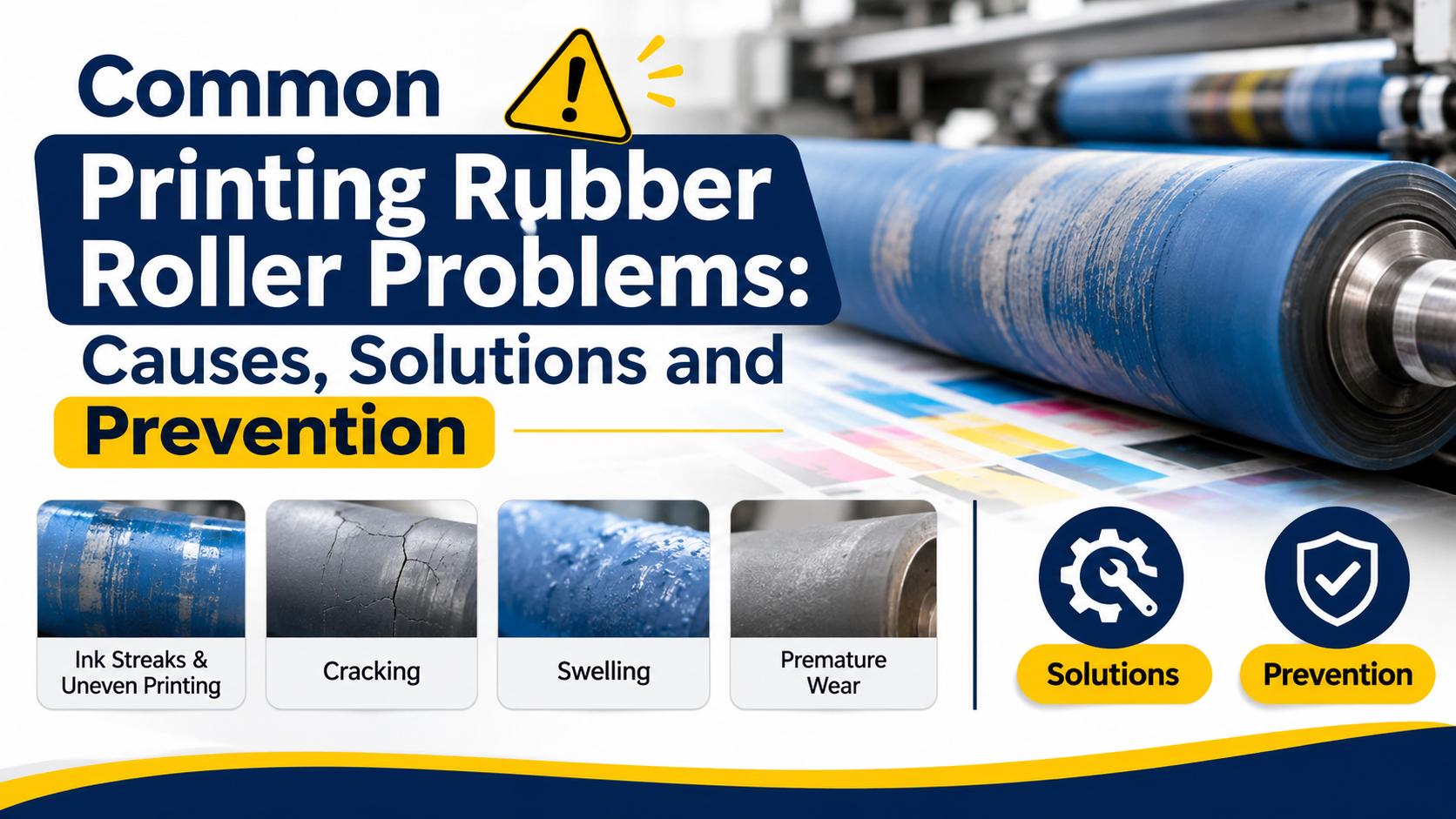
Printing rubber roller problems such as hardness increase, inconsistent ink transfer, surface damage, chemical deposits, swelling, roller hanging and premature wear can affect both print consistency and production efficiency.
The solution is not always a higher-grade or more expensive roller. The more important step is understanding the actual cause of the problem and selecting a roller specification suited to the application.
The right compound, hardness, surface finish, dimensions and chemical compatibility can help the roller perform consistently under its intended operating conditions.
For printers, therefore, choosing the right printing rubber roller is not just about finding a replacement. It is about finding a roller that is technically suited to the printing process and the conditions in which it will operate.
Max Rollers focuses on application-specific printing rubber rollers designed around the machine, ink, process and operating requirements of the customer.
Looking for the Right Rubber Roller Solution?
Choosing the right offset printing rubber roller is essential for achieving consistent print quality, smooth operations, and long-lasting performance. Whether you need expert guidance, customized rubber rollers, or reliable manufacturing solutions, our team is here to help.
Get in touch with us today! Let our experts understand your requirements and help you find the right solution for your application.
Contact Us Today to discuss your requirements and get expert assistance.
